

Streaming sold itself on simplicity. Press play. Watch the film.
The viewer sees a button. The rights holder sees a logistics operation that quietly eats every margin streaming was supposed to deliver.
Distrotech is the term for the layer beneath the play button. The pipes, the encoders, the metadata, the reporting. It is where the actual cost of being on every platform shows up.
And almost nobody talks about it in public.
The Bandwidth Bill Nobody Reads
Every minute a film streams, someone pays for the bandwidth. That cost sits with the CDN. The CDN bills the platform. The platform passes some of that cost back into the deal.
For a single mid-tier title that reaches reasonable scale, CDN egress can run into six figures a year. For a catalogue holder with hundreds of titles, the maths gets serious quickly.
The bill is invisible until it is not. A successful release that surprises a small platform can wipe out the upside in the contract. The film does well. The economics do not.
Most rights holders never see the line items. They see a smaller share of revenue and assume that is just how the platform negotiates.
It is not. It is the cost of moving the bytes.
Every Platform Wants the File in a Different Shape
You finished the master. You signed the deal. Now the work begins.
Every platform has its own delivery specification. Codec. Bitrate. Container. Frame rate. Colour space. HDR metadata. Loudness target. Closed caption format. The list runs to twenty pages on the major platforms.
You build a transcode pipeline. You re-encode the master for each destination. If the platform changes its spec, you re-encode again.
For an independent producer with one film, this means hiring a post-production house for six weeks and writing a cheque you did not budget for. For a distributor managing a slate, it means a dedicated ops team and a transcode farm running around the clock.
The cost is real. The cost is recurring. The cost rarely shows up in the press release announcing the platform deal.
Metadata Is Where Time Goes to Die
Then come the assets that travel alongside the video.
Title metadata in multiple languages. Synopsis in long and short form. Cast and crew credits formatted to the platform’s internal taxonomy. Genre tags from a closed list that does not match anyone else’s closed list.
Artwork in eight aspect ratios. Subtitles in twenty languages. Audio stems in stereo, 5.1, Atmos, descriptive audio. Trailers cut to platform-specific durations.
Every platform has its own portal. Every portal has its own template. Every template breaks if you change one field.
A delivery to a single major platform can take three weeks of work from someone who does this for a living. A delivery to ten platforms can take a quarter.
The clock starts at signing. The platform will not pay until delivery is accepted. The interest cost on the production loan keeps running.
Two Operations Teams. One Delivery. Months of Back and Forth.
The cost is not only on your side.
The platform runs an ops team too. They receive your files. They run QC. They flag the metadata field you formatted incorrectly. They send the package back. You fix it. You resend.
This loop - flag, fix, resend - can run for weeks on a single title. Multiply it by every platform, every territory, every release window on a full slate, and you have hundreds of hours of skilled labour on both sides of the table, spent on a handshake that should have taken an afternoon.
The combined ops cost of getting content onto streaming platforms is one of the industry’s least visible and most expensive problems. Humans are still doing most of it by hand, in 2026, because the systems were never designed to talk to each other.
Both sides know it is broken. Both sides budget for it anyway. Neither side built the layer that would fix it - because fixing it meant solving a problem that sat between them, and nobody owned the middle.
The Data Does Not Come Back
The film is now live. The viewers are watching. The platform knows everything about them.
You know almost nothing.
You get a monthly report. View counts, sometimes by territory. A revenue line. A statement showing the platform’s calculation of your share. No names. No emails. No retention data. No insight into what drove the spike on day nine.
You cannot email those viewers when your next film comes out. You cannot build a community. You cannot price-test. You cannot do anything that resembles a modern audience relationship.
You delivered the content. The platform kept the audience.
Payment Comes Back in a Hundred Pieces
The revenue arrives slowly. Monthly statements from each platform. Different currencies. Different reporting cycles. Different definitions of a qualifying view.
A distributor with thirty titles across ten platforms in fifteen territories is reconciling hundreds of statements every month. Manually. In spreadsheets. With one full-time finance hire whose only job is to chase missing payments and challenge platform calculations.
The administrative cost of getting paid eats further into a margin that was already thin.
The Fix
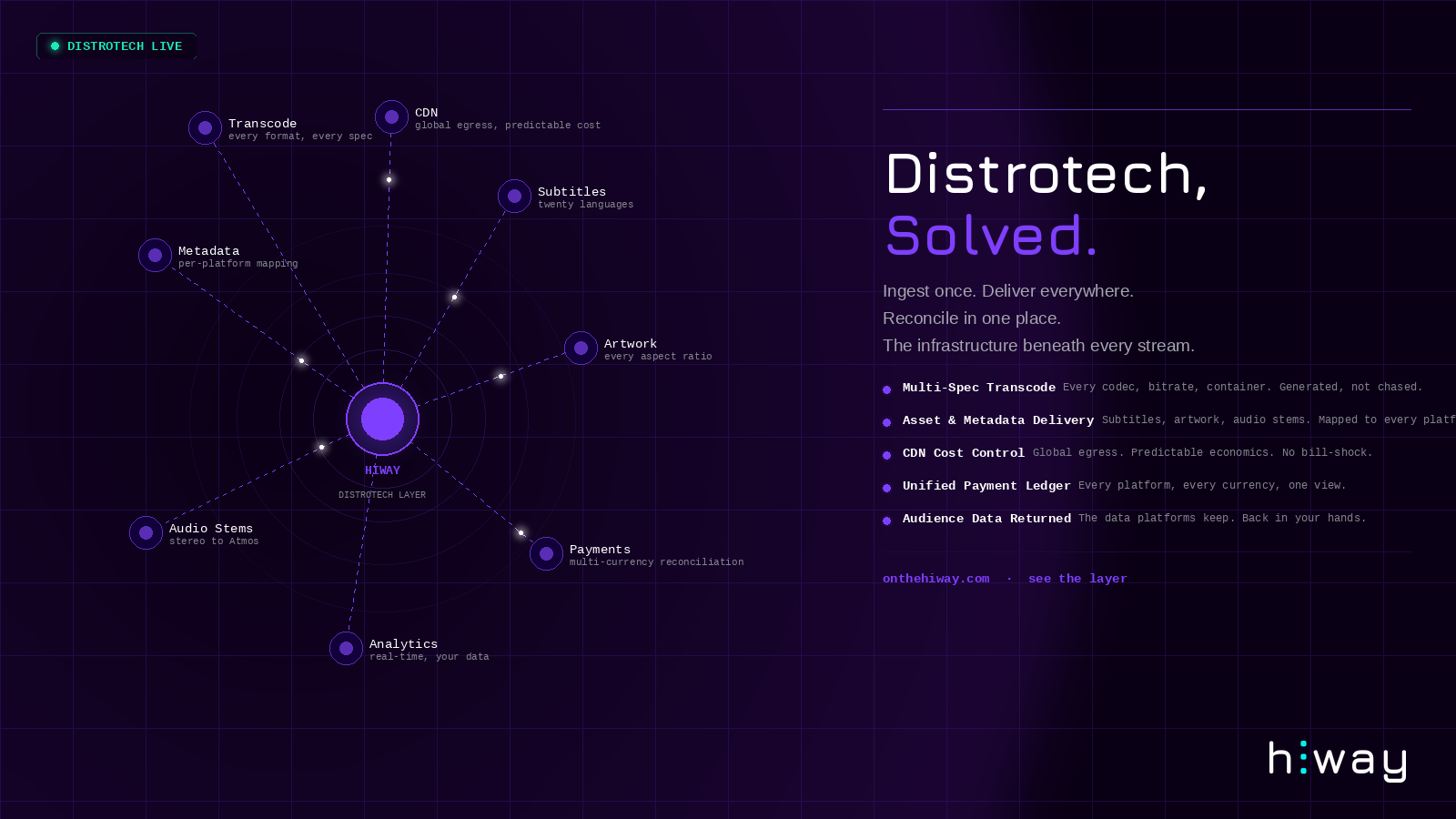
The infrastructure problem has always been the same. Storage is in one place. Encoding in another. Delivery in a third. Payments in a fourth. Reporting in a fifth. None of these systems talk to each other. All of them charge.
Hiway is the layer that connects them. One system to ingest the master. One pipeline to deliver to every destination, including direct-to-fan. One ledger for every payment, in every currency, across every territory. One source of truth for the data the platforms keep for themselves.
The point is not to replace streaming platforms. It is to make putting content on them — and selling it directly alongside them, run on the same set of pipes. Without the duplicated ops cost on either side. Without the lost audience relationship. Without the months of integration work for every new deal.
Content owners keep their IP. Their audience data. The majority of their revenue.
The distrotech tax is real. It does not have to be permanent.