

Scotflix is the next Hiway-powered streaming platform built on the principle that the media stays with the person who made it. No ingestion. No CDN. No storage cost. One architectural decision that rewrites the economics of independent streaming from the ground up.
Most streaming platforms fail. Not because the content is bad. Because the cost of running the machine is too high.
Ingestion. Transcoding. Storage. CDN delivery. Quality control. Metadata management. Payment reconciliation. These are the operating costs that sit underneath every Netflix-style service, and they scale with every title, every view, every territory. For an independent platform without Netflix’s volume, those costs arrive before a single subscriber does.
Scotflix, which launched on 12 September 2026 at the Scottish Screenwriters Festival in Glasgow, was built on a different premise entirely. The file never moves.
What “the file never moves” actually means
On every traditional streaming platform, the process works roughly like this. The content owner delivers the master file to the platform. The platform ingests it, runs quality control, transcodes it into multiple formats, stores it on its own servers, and streams it to viewers via a content delivery network. The platform owns the delivery chain from that point on. It controls what the viewer sees, what data is collected, and when the content owner gets paid.
On Scotflix, none of that happens.
Each film, series, short or podcast is uploaded once into the content owner’s own Hiway account, their single library. The owner sets the metadata, artwork, audio tracks and subtitles once. To appear on Scotflix, they send a digital syndication contract, not a file. That contract defines the revenue split, the term, the territories, the pricing, and what data flows between the two parties. Scotflix reviews and approves, and the title appears on the platform automatically.
When a viewer presses play on Scotflix, the stream is technically served from the owner’s library, not the platform’s servers.
The platform never touches the media. Not during onboarding. Not during streaming. Not ever. That is not a feature. It is a different architecture.
What disappears when the file does not move
The implications for a platform’s cost structure are significant. Let me be specific about what is simply no longer there. A traditional platform carries all of this:
Media delivery and file transfer from content owners.
Ingestion, transcoding and format conversion.
Content storage at scale.
CDN streaming costs, which grow with every view.
Quality control and compliance processing.
Payment reconciliation and 90-day reporting windows.
Separate reporting obligations to each content owner.
Scotflix carries two things instead: curation, deciding what belongs on the platform, and marketing, finding the audience and growing it.
That is the economic inversion. And it matters more than it might first appear.
On a traditional streaming platform, every pound of revenue has to cover the infrastructure before it can do anything useful. CDN costs scale with views. Storage costs scale with titles. Transcoding costs arrive before the first subscriber. The machine has to be fed constantly, regardless of whether the platform is growing or not.
On Scotflix, those costs do not exist. Which means every pound the platform generates can go directly into the two things that actually build a streaming business: promoting the content and finding the audience.
This is not a marginal efficiency gain. It is a structural reallocation of where the money goes. The platform operator is not choosing between keeping the lights on and running a marketing campaign. The lights cost nothing to keep on. The entire commercial focus can be on growth.
For a content owner, the implication is equally direct. Your film is not sitting in a library hoping to be found. The platform has a genuine financial incentive to put its marketing resource behind your work, because marketing is the only significant cost it has. That alignment between platform and content owner does not exist on the traditional model, where the platform’s operational costs absorb most of the margin before marketing gets a look-in.
Scotflix went from idea to launched platform in just over a month. No technical team was hired. No infrastructure was built. The barrier to launching a streaming service just changed.
What the filmmaker gets that they have never had before
The shift in the platform’s economics is interesting. What the content owner gets is more fundamental.
The file never leaves their possession. They remain the merchant of record through their own connected Stripe account, which means their share of every transaction arrives in their bank account at the moment of purchase, not in a 90-day payment window, not in a quarterly statement, not after a recoupment calculation.
They see live analytics: every view, every watch-time metric, every territory, every transaction. Not a report sent monthly by the platform. Their own dashboard, in real time.
They capture the viewer data. Both the platform and the content owner build their own customer record at the point of purchase. The filmmaker now has a direct audience they can market to for future work. That has not been possible through traditional distribution before.
The commercial terms on Scotflix reflect where the value actually sits. Hiway takes 10% off the top as a transaction fee. The remaining split is weighted to the content owner, on non-exclusive 24-month terms with no minimum guarantees at launch.
For a filmmaker whose previous experience of distribution involved signing away rights, waiting years for payments, and never knowing who their audience was, these terms represent a genuine structural change.
One file in one place is inherently more secure
There is a security argument that does not get discussed enough in this context.
The biggest piracy risk in traditional distribution is not the streaming itself. It is the movement of the master. Every time a file is delivered to a new party, transcoded, stored on a new server, or sent as a screener link, a new leak point is created. Most unauthorised copies of films originate from somewhere in that chain, not from someone ripping a stream.
When the file never moves, most of those leak points disappear. One file. One location. Owner-controlled.
The streaming and content security infrastructure running underneath Scotflix includes studio-grade DRM. Territory rights are enforced in the link itself: geo-blocking per title, per market, with different pricing per territory if needed.
A title that is cleared only for Canada and not the UK can be live in one and blocked in the other with a few clicks. Partially-cleared catalogue, which is normally unsellable because the rights do not line up across markets, becomes monetisable inventory market by market. That is a real commercial gain for any rights holder sitting on a library with complex territorial splits.
When the commercial logic lives in the link, not the platform
There is a further dimension that follows directly from this architecture.
Because the commercial terms live in the syndication contract rather than in a platform agreement, the same model can power an affiliate layer. Cast, crew, influencers and fans can receive unique links and earn a share of every sale they drive. The audience is found where it already lives: across social media, in WhatsApp groups, in newsletters, in communities. Every stream still comes from the owner’s library. Every sale still pays them in real time. Every viewer’s data still flows back to them.
The community markets the platform. Marketing cost falls too.
This is why Scotflix does not need a significant marketing budget to reach a Scottish diaspora that exists from Boston to Melbourne. The content itself, distributed through the people connected to it, is the marketing.
A country the size of Scotland can now sustain its own streamer
Scotflix is a Scottish platform for Scottish stories. But the significance of what launched on 12 September is not limited to Scotland.
The same infrastructure already powers Raindance Releasing, the direct distribution arm of the Raindance Film Festival, which launched earlier this year with 20 founding films and zero CDN costs. More platforms are in development internationally, due to launch in the coming weeks.
The underlying argument is straightforward. Streaming platforms do not fail because of bad content. They fail because of the cost of the machine. Remove the machine, and the economics of independent streaming change at every level of scale. A film community, a festival, a national cinema, a distributor, a rights holder with a back catalogue, all of them can now build a direct-to-audience platform at a fraction of the cost and the complexity that previously made it impractical.
Maureen Hascoet, Founder of Scotflix and Firewalker Pictures, on why the platform exists.
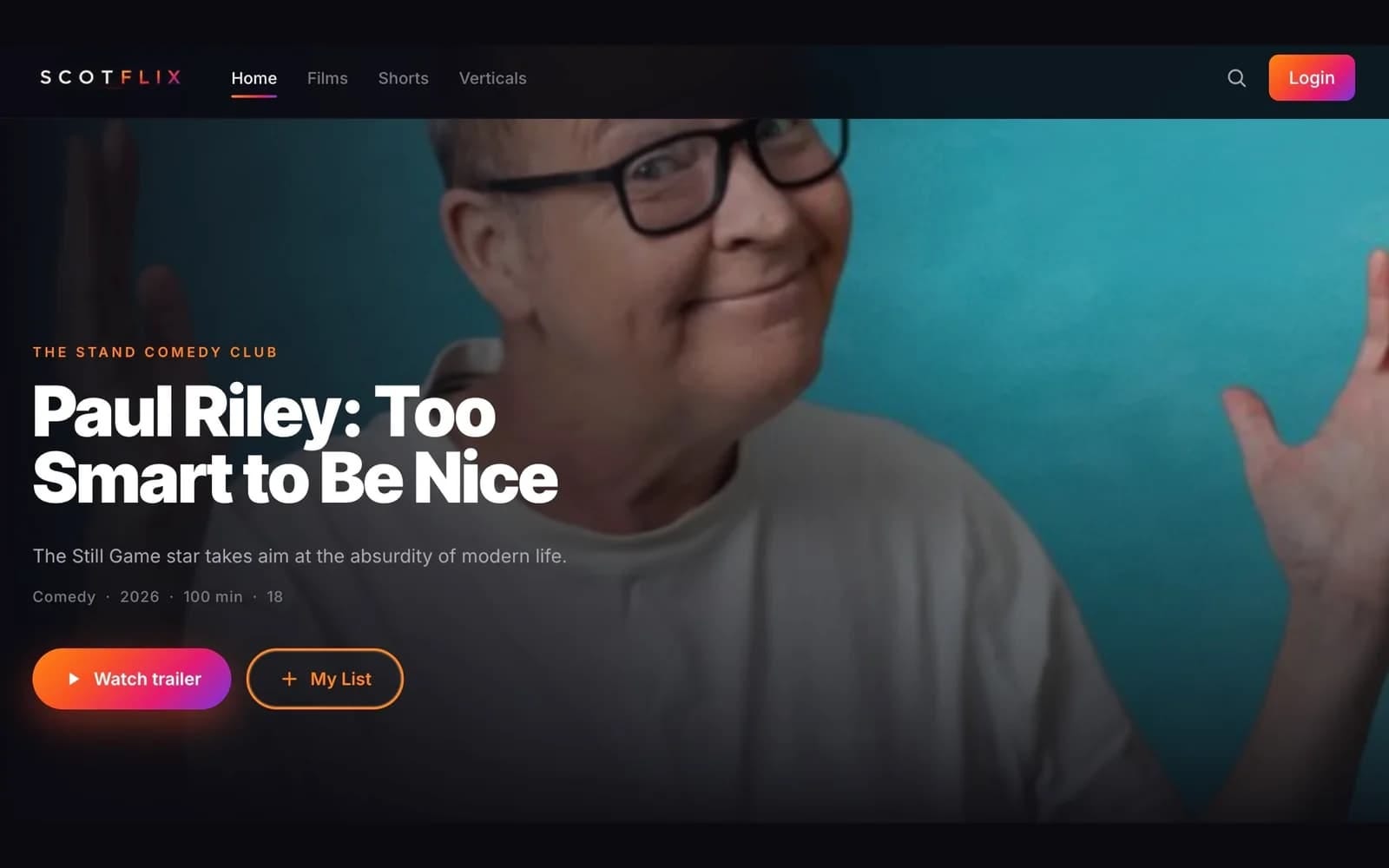
The platform launched with Paul Riley’s exclusive stand-up special, documentaries, animation and horror, with major distributors in active discussion. Accounts start at £12 a month, which is roughly 40p a day, so the barrier for a filmmaker to participate is genuinely low.
This is not Hiway building another platform. Hiway is the infrastructure. Scotflix is what someone built on it in just over a month, with its first content partners already onboard.
That is the point.
What is Scotflix and how does it work?
Scotflix is a streaming platform for Scottish screen stories, launched on 12 September 2026 at the Scottish Screenwriters Festival in Glasgow, powered by Hiway. Unlike traditional streaming platforms, Scotflix never ingests or stores the media files. Each film streams directly from the content owner’s own Hiway library via a digital syndication contract rather than a file transfer.
How does streaming without CDN costs work?
What do content owners keep on Scotflix?
Why do most independent streaming platforms fail?
How can I launch a streaming platform like Scotflix?
Start today
Put this into practice
Start free with 5 GB and one title. Price it, share one link, and keep 90% of every sale.