

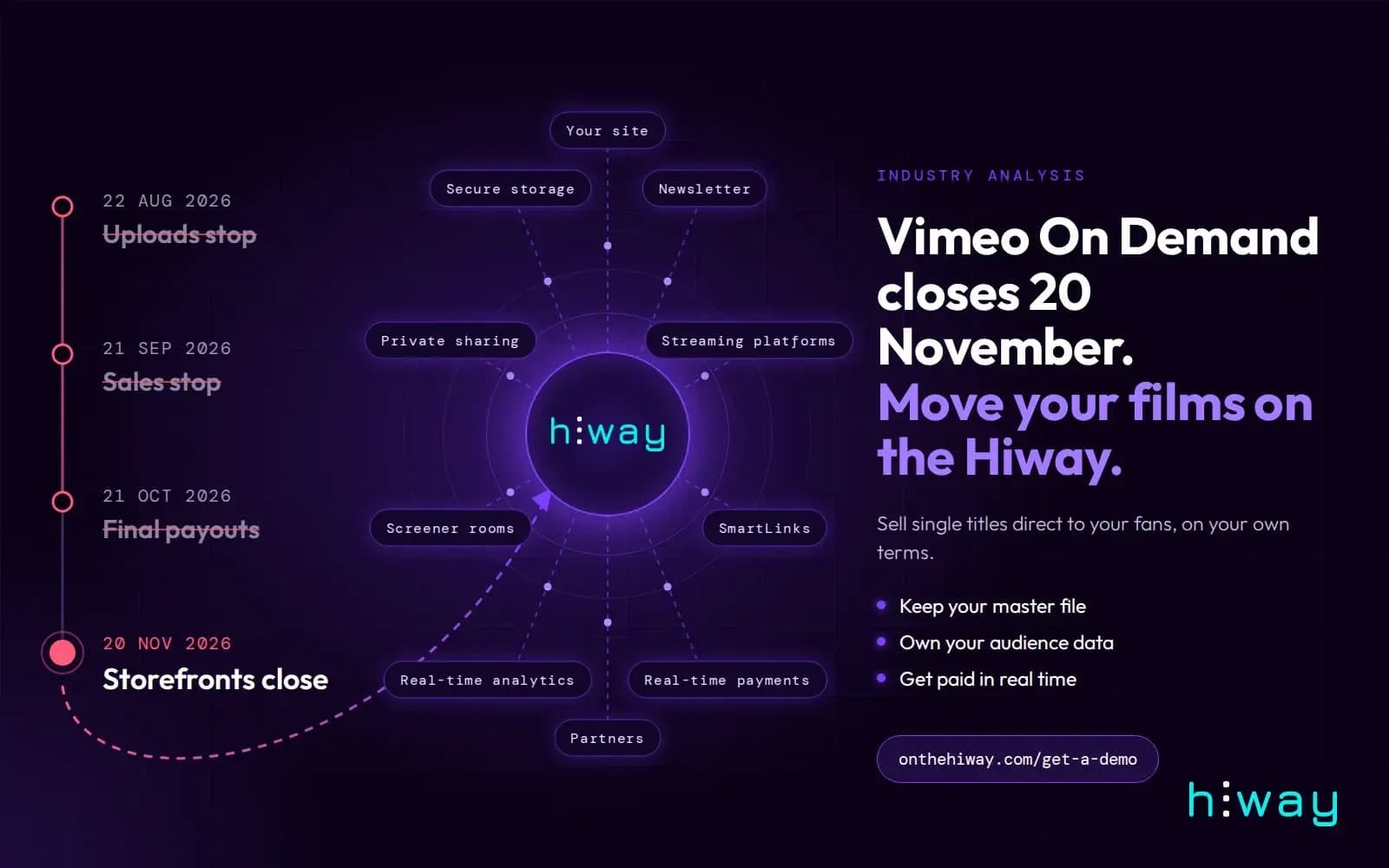
A twenty-year-old marketplace closes on 20 November 2026. The alternative Vimeo is pointing sellers to isn’t built for most of them. Here’s what actually comes next.
Quick answer: what is happening with Vimeo On Demand?
Vimeo On Demand is closing on 20 November 2026.
Uploads stopped on 22 August 2026. New sales stopped on 21 September 2026.
Final seller payouts land by 21 October 2026. All viewer access ends 20 November 2026.
Vimeo is pushing sellers to Vimeo Streaming (formerly Vimeo OTT), which is built for organisations running their own subscription channel, not for individual filmmakers and coaches selling a title now and again.
The best alternative for direct-to-fan sellers is infrastructure that lets you sell single titles, keep your master file, own your audience data and get paid in real time.
The end of a chapter that started in 2004
Vimeo launched in 2004 as a side project from a small team who wanted a nicer home for their own videos than YouTube offered. For a decade, it was the internet’s professional video corner. Better encoding, better player, no ads, no “up next” chum. Filmmakers uploaded there because Vimeo felt like a place that respected craft.
In 2013 it launched Vimeo On Demand, the first serious attempt at giving independent filmmakers a direct-to-fan storefront. For a long time it worked. Sellers put their films on the marketplace, kept a version of the audience relationship, and pocketed a share of every sale. If you were an indie director in the 2010s, a documentary maker with a small following, a yoga teacher building a course, Vimeo On Demand was where you went.
Then the pivots started. Vimeo turned its focus to enterprise SaaS. It spun out of IAC and went public in 2021. The share price collapsed nearly 90%. In September 2025, Bending Spoons, the Milan-based holding company that also owns Evernote, Meetup, WeTransfer and Splice, announced a $1.38 billion all-cash acquisition. The deal closed in November 2025.
Within two months, the video and engineering teams were largely laid off. Eight months after that, Vimeo On Demand had a shutdown notice.
The exact timeline every Vimeo On Demand seller needs to know
The company published a fixed calendar. There is no extension.
22 August 2026. New uploads to Vimeo On Demand blocked.
21 September 2026. New purchases and subscriptions blocked.
21 October 2026. Final payouts processed under the existing Seller Addendum.
20 November 2026. Vimeo On Demand storefronts go offline. Viewer access ends. Download links, viewer libraries, everything.
If you sell on Vimeo On Demand and have not started planning your move, you have roughly eight weeks. If your customers have not been told to download the titles they own, that is on the clock too.
Why Vimeo Streaming is not the answer for most sellers
Vimeo is pointing displaced sellers at Vimeo Streaming, formerly Vimeo OTT. On paper it looks like a migration path. In practice, it isn’t the same product.
Vimeo Streaming is built for organisations running a subscription channel. A yoga studio with a monthly membership. A media company launching an SVOD service. A production house with enough back catalogue to justify a monthly fee. If that is not you, if you’re a filmmaker who wants to sell a title, or a coach with a handful of courses, or a small business with training videos to license, Vimeo Streaming is asking you to build a product you never needed.
The pricing tells the story. Vimeo Streaming charges a per-subscriber monthly fee, roughly $1 per subscriber per month, plus payment processing. Transactional sales carry a 10% service fee plus $0.50 per transaction. Extra upload hours are sold in $99 to $199 blocks. There is no fixed platform fee, but the moment you have any real activity the fees stack.
For a filmmaker with a single documentary to sell, this is a bad shape. For a coach with three online courses, it’s worse.
What sellers actually need from the next platform
If you built a business on Vimeo On Demand, you probably need six things, in this order:
The ability to sell a title without building a channel. No subscriber threshold. No monthly per-subscriber cost.
Your master file to stay with you. Not sitting on a platform that can pull the plug in eight weeks.
Your audience data. Who bought. Where they watched. How long. So that when you release the next film, you can email them directly.
Real-time payouts. Money in your bank the same day someone watches, not a monthly report and a 60-day wait.
Simple rights control. Territory-by-territory pricing. Geo-blocking that actually works. Windows you can set yourself.
A way to grow. Not just a place to sell, but tools to recruit fans, cast, crew and partners to share and earn from every sale.
That list is not exotic. It is what the direct-to-fan economy has been asking for since Vimeo On Demand launched in 2013.
Hiway: the infrastructure built for the direct-to-fan era
Hiway is not another streaming platform. It’s the infrastructure layer underneath one. Think Shopify for content, not Netflix for viewers.
You upload once. You set the price, the territory and the windows. You share a SmartLink anywhere online, on your own site, in a newsletter, on Instagram, via an influencer. When someone watches or buys, the money splits automatically and lands in your account the same day. Every stream, every transaction, every viewer stays visible in your dashboard.
Your content. Your fans. Your money. On the Hiway. That is not a pitch line invented for this blog. It is the entire product. Everything Vimeo On Demand promised in 2013, without the parts of Vimeo Streaming that don’t fit you.
How Hiway compares to Vimeo Streaming for direct-to-fan sellers
Sell a single title. Yes on Hiway. Vimeo Streaming asks you to build a subscription channel.
Keep your master file. Yes on Hiway. Content never leaves your account. Even when partners embed it on their platforms, the file streams from your library.
Own the audience data. Yes on Hiway. First-party data on every viewer and transaction. Vimeo Streaming keeps the audience relationship with the platform.
Payout speed. Real time on Hiway. Money in your account the same day someone watches.
Pricing. Free to start, then £12 a month, and a flat 10% on viewer transactions. No per-subscriber fee. No upload-hour blocks.
Rights control. Geo-blocking, territory pricing, windowing, all in the dashboard. Set the terms yourself.
Syndication. Give a fan, an influencer, a festival or a cast member a unique link. They share it, they earn a cut of every sale, tracked automatically.
How to migrate off Vimeo On Demand in a weekend
For most sellers it takes about a day. For a full catalogue we’ve done it inside forty-eight hours. The steps are the same as they would be on any platform, but the process is designed to be self-serve.
Create a free Hiway account at portal.onthehiway.com.
Download your master files from Vimeo. Do this while download links still exist. Vimeo is telling viewers to download what they own before 20 November, so do the same on the seller side.
Upload once to Hiway. Set the price per territory. Add your metadata. Publish.
Generate SmartLinks for your own website, your newsletter, and any affiliate or partner site.
Email your Vimeo audience the new watch link. If you exported your customer list before the shutdown, that email should have gone out the day the timeline was published. If you didn’t, do it now.
Turn on syndication for anyone you want to help promote your content. They get a link. You both get paid on every sale, automatically.
If you have a large catalogue or a complex rights position, we’ll do the migration with you. Partners who embed your titles stream them straight from your library, so nothing is duplicated along the way.
Why this shutdown matters beyond Vimeo
The bigger story is not Vimeo. It is that thousands of independent creators built businesses on a platform that has now decided their part of it isn’t worth resourcing. The same could happen on YouTube. It has happened on Patreon. It happens whenever an audience relationship you built is held on someone else’s rails.
The lesson every independent filmmaker, educator, coach and creator can take from this is simple. Own your content. Own your audience. Own your revenue. Then no platform’s business decision can take any of it away.
Hiway exists because the industry needed this ten years ago. Vimeo On Demand almost got there. Vimeo Streaming, run by owners with a different playbook, is not going to. That is the gap we built to close.
What to do this week
If you have content on Vimeo On Demand:
Download your master files now. Don’t wait until November.
Export your customer list if you can. Email them the new watch link once you’ve moved.
Book a migration call, or start straight away at portal.onthehiway.com.
The first month of pay-per-view transaction commission is on the house for any Vimeo On Demand seller who moves before 20 November 2026.
The window is short. The next platform you build on should be the last time you build on somebody else’s.
What is happening to Vimeo On Demand?
Vimeo On Demand is being shut down. New uploads were blocked on 22 August 2026. New purchases were blocked on 21 September 2026. Final payouts land by 21 October 2026. The platform closes for good on 20 November 2026. All viewer access ends on the same day.
Why is Vimeo shutting down Vimeo On Demand?
Is Vimeo Streaming the same as Vimeo On Demand?
What is the best Vimeo On Demand alternative for filmmakers?
How much does Hiway cost compared to Vimeo?
How do I move my Vimeo On Demand catalogue to Hiway?
Do I still own my film if I sell it on Hiway?
What happens to my Vimeo On Demand customers on 20 November 2026?
More on Industry Analysis
Industry AnalysisScotflix Launched on 12 September. The Content Never Moved. That Changes Everything.
Start today
Put this into practice
Start free with 5 GB and one title. Price it, share one link, and keep 90% of every sale.